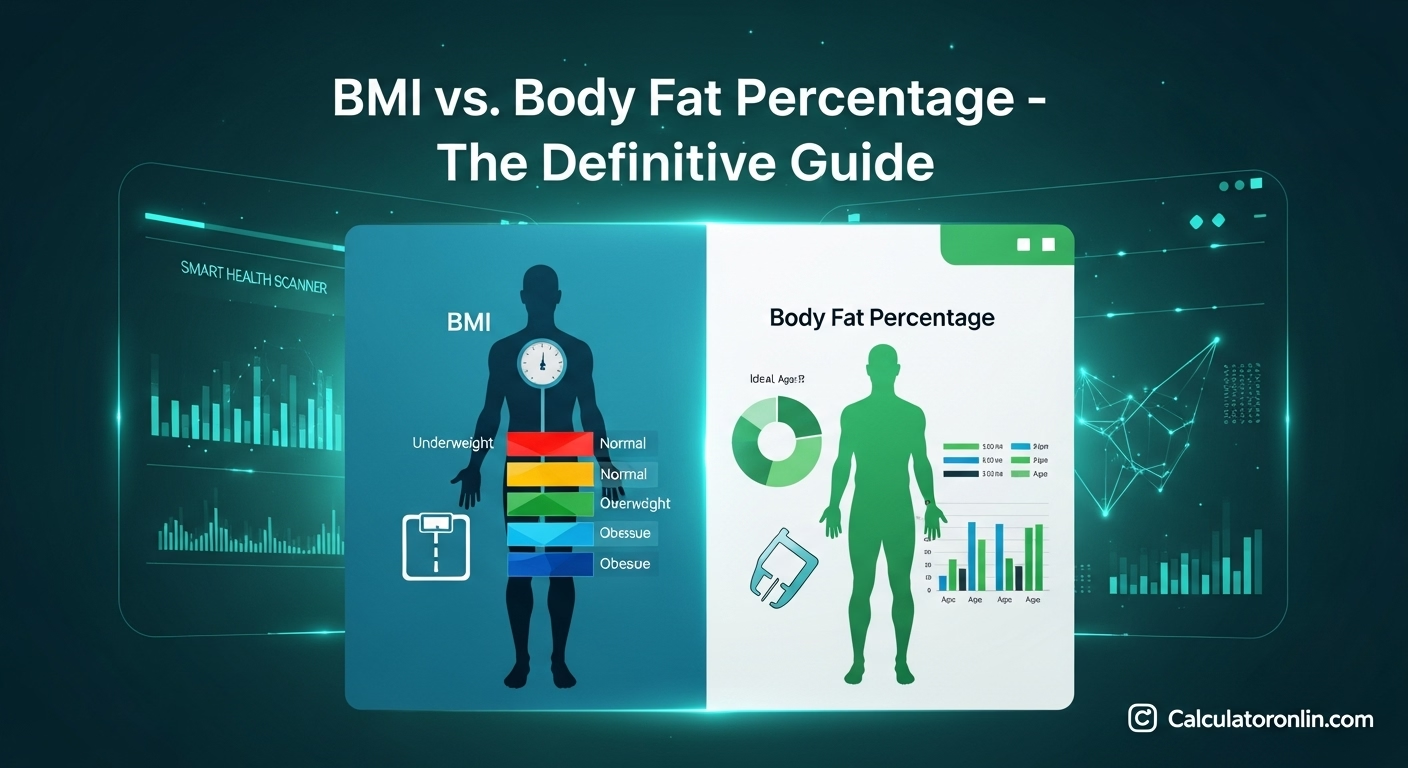
Introduction: Beyond the Scale
For decades, the Body Mass Index (BMI) has been the go-to metric for assessing health and weight. But the fitness world has evolved, and the limitations of BMI are now widely recognized. If you are serious about health, fitness, and longevity, you need to look beyond the simple weight-to-height ratio. The critical question is: “how to measure body fat percentage” and why is this number a far superior indicator of your health?
This definitive guide will compare BMI and body fat percentage, explain why body composition is the true measure of fitness, and show you how to accurately estimate your body fat to set smarter, more effective health goals.
Section 1: The Flaw in the BMI Formula
BMI is calculated by dividing your weight in kilograms by the square of your height in meters (kg/m²). It was developed in the 19th century by a Belgian mathematician, not a physician, and was intended for population studies, not individual diagnosis 5.
You must read: Calories Calculator: Diet Made Simple
1.1. The “Skinny Fat” Paradox
The biggest flaw in BMI is its inability to distinguish between fat mass and lean mass (muscle, bone, water). This leads to two common paradoxes:
1.The Athlete Paradox: Highly muscular individuals (e.g., bodybuilders, professional athletes) often have a high BMI, classifying them as “overweight” or “obese,” despite having very low body fat and excellent health.
2.The “Skinny Fat” Paradox (TOFI: Thin Outside, Fat Inside): Individuals who appear thin may have a “normal” BMI but carry a dangerously high percentage of visceral fat (fat around the organs), putting them at high risk for metabolic diseases.
Section 2: Body Fat Percentage – The True Health Indicator
Body Fat Percentage is the proportion of your total body mass that is composed of fat. This metric is a much more accurate predictor of health risks, including cardiovascular disease, type 2 diabetes, and hypertension.
2.1. Healthy Ranges
Healthy body fat ranges differ significantly between men and women due to biological necessity.
•Men: Essential fat (2-5%), Athletes (6-13%), Fitness (14-17%), Acceptable (18-24%).
•Women: Essential fat (10-13%), Athletes (14-20%), Fitness (21-24%), Acceptable (25-31%).
Section 3: Methods for Measuring Body Fat Percentage
While the question is how to measure body fat percentage, the answer involves a spectrum of accuracy and cost.
3.1. Gold Standard Methods (Highly Accurate)
•DEXA Scan (Dual-Energy X-ray Absorptiometry): The most accurate, providing a detailed breakdown of bone, lean, and fat mass.
•Hydrostatic Weighing (Underwater Weighing): Measures body density by submerging the person in water.
3.2. Practical, Accessible Methods (Good Estimates)
•Skinfold Calipers: Measures the thickness of subcutaneous fat at various points on the body. Requires training for accuracy.
•Bioelectrical Impedance Analysis (BIA): Devices (like smart scales) send a small electrical current through the body. Accuracy can be affected by hydration levels.
•Circumference Measurements: Uses measurements of the waist, neck, and hips in conjunction with established formulas (like the U.S. Navy method) to estimate body fat.
Section 4: Connecting Body Composition to Calorie Needs
Your body composition directly impacts your metabolism. Muscle tissue is more metabolically active than fat tissue, meaning it burns more calories at rest. Therefore, understanding your body fat percentage is crucial for setting accurate calorie goals.
For a deeper dive into how your body burns energy and how to calculate your daily calorie needs based on your activity level, be sure to read our guide on TDEE and BMR: The Secret to Personalized Calorie Counting 6.
Section 5: The Funnel to Accurate Assessment
While DEXA scans are expensive and BIA scales can be inconsistent, the circumference measurement method provides a reliable, accessible estimate. However, manually applying the complex formulas (which involve logarithms and multiple variables) is cumbersome and prone to calculation errors.
You need a tool that can instantly and accurately apply these complex formulas based on simple, easy-to-take measurements.
To get a reliable, free estimate of your body fat percentage using the proven U.S. Navy or YMCA methods, use our free Body Fat Calculator.
Conclusion: Measure What Matters
Moving from BMI to body fat percentage is a crucial step in taking control of your health journey. It allows you to set goals that focus on building lean muscle and reducing fat mass, rather than just chasing a number on the scale. Use the knowledge in this guide and the precision of our tool to measure what truly matters.
Click here to use the Body Fat Calculator now and gain a deeper understanding of your body composition.