For students and professionals bridging the Atlantic, few academic tasks are as critical—and as confusing—as translating educational achievements from one system to another. A stellar UK degree classification can seem like an enigma to a US graduate admissions committee or a hiring manager in New York. Conversely, a UK employer reviewing a transcript from a US university might struggle to interpret a 3.7 GPA.
This guide demystifies the process, providing you with the definitive methodology to accurately convert your UK university grades to the US 4.0 Grade Point Average (GPA) scale. Whether you’re applying to a top-tier MBA program in the United States, seeking employment with a multinational corporation, or simply need to standardize your academic record, mastering this conversion is a non-negotiable step in your international journey. We’ll equip you with standard formulas, step-by-step instructions, and direct access to tools like our Calculator for instant, reliable results.
The US 4.0 GPA System Explained (A-F Scale)
The US GPA system is a cumulative, numerical average of a student’s performance across all courses (or “modules”). It operates on a sliding scale, typically from 0.0 to 4.0, where each letter grade corresponds to a specific number of “grade points.”
The core of the system is this standard mapping:
- A (Excellent): 4.0 grade points (often subdivided into A+ = 4.3, A = 4.0, A- = 3.7, though the 4.0 cap is standard for cumulative GPA).
- B (Good): 3.0 grade points (B+ = 3.3, B = 3.0, B- = 2.7).
- C (Satisfactory): 2.0 grade points (C+ = 2.3, C = 2.0, C- = 1.7).
- D (Passing, but poor): 1.0 grade point.
- F (Fail): 0.0 grade points.
How it’s calculated: For each course, the earned grade points are multiplied by the course’s credit hours (a unit representing the course’s weight or time commitment). The sum of all (grade points × credit hours) is then divided by the total number of credit hours attempted. This yields the cumulative GPA. The system is granular, sensitive to small performance differences in individual classes, and designed to reflect consistency over an entire program.
The UK Degree Classification System (First, 2:1, 2:2, Third)
In stark contrast, the UK system focuses on the final degree outcome, classifying it into distinct honors categories based on overall performance. The emphasis is less on a running average and more on the aggregate result of exams, dissertations, and coursework at the end of the program.
The standard classifications for an undergraduate honors degree are:
- First-Class Honours (1st): The highest award, typically requiring a final average of 70% or above. It denotes exceptional, world-class performance.
- Upper Second-Class Honours (2:1): The most common target for graduate employers, usually requiring 60-69%. It signals a strong, above-average performance.
- Lower Second-Class Honours (2:2): Generally awarded for averages of 50-59%. It is a pass, but may limit options for competitive postgraduate programs or roles.
- Third-Class Honours (3rd): Awarded for 40-49%. It is a pass, but considered a bare minimum.
- Ordinary Degree (Pass): Awarded for work below 40% but meeting specific pass criteria (less common).
Crucially, UK grading is often perceived as more stringent at the top end; a score of 70% (a First) is considered excellent, whereas in many US contexts, an A (90-100%) is the top benchmark. This philosophical difference in marking is the root cause of conversion complexity.
The Standard Conversion Formulas and Methods
There is no single, universally mandated conversion formula. However, several established methods are widely accepted by universities, credential evaluators, and employers. The key is to apply the method consistently and transparently.
Direct Conversion Tables (The Most Common Method)
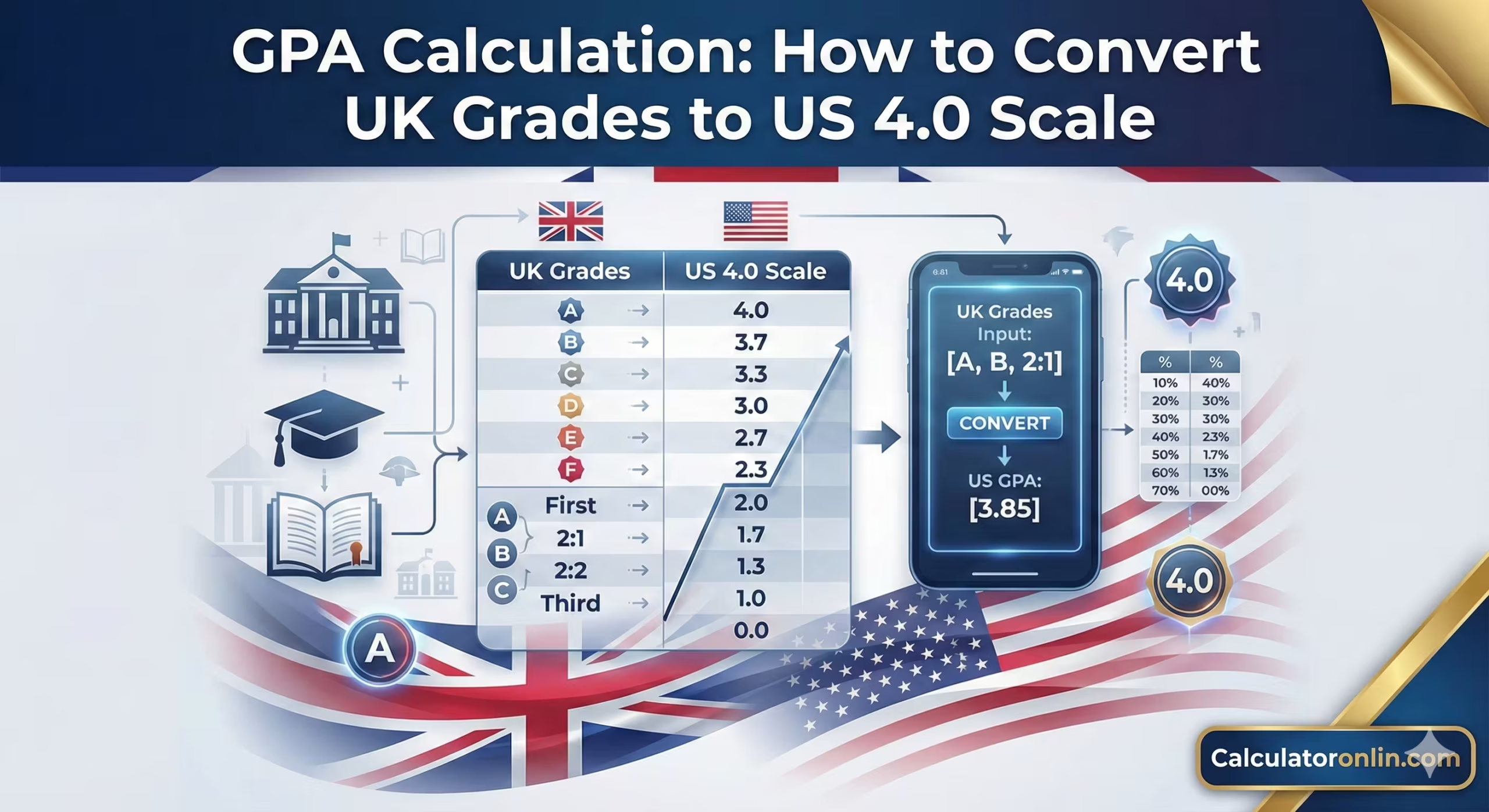
This is the simplest approach, mapping the final UK degree classification directly to an equivalent US GPA range. It provides a quick, high-level overview but lacks the granularity for a detailed transcript conversion.
| UK Degree Classification | Typical Final Mark % | Approximate US GPA Equivalent (on 4.0 scale) |
|---|---|---|
| First-Class Honours (1st) | 70% – 100% | 3.7 – 4.0 |
| Upper Second-Class (2:1) | 60% – 69% | 3.0 – 3.6 |
| Lower Second-Class (2:2) | 50% – 59% | 2.5 – 2.9 |
| Third-Class Honours (3rd) | 40% – 49% | 2.0 – 2.4 |
| Ordinary Degree (Pass) | 35% – 39% | < 2.0 |
Limitation: This table doesn’t help if you need to convert individual module grades for a detailed transcript, which is often required for graduate school applications.
The WES (World Education Services) Methodology (The Gold Standard for US/Canada)
For official purposes, especially graduate admissions to US and Canadian institutions, a credential evaluation report from an organization like World Education Services (WES) is often required or strongly recommended. WES uses a sophisticated, course-by-course analysis that considers the rigor of your specific UK institution.
While WES does not publish its exact algorithm, its general approach for UK grades is well-understood:
- Individual Module Conversion: Each UK module mark is converted to a US letter grade/grade point based on a nuanced scale. For example, a 75% (a solid First) might be mapped to an A (4.0), while a 68% (a high 2:1) might be mapped to a B+ (3.3).
- Credit Hour Assignment: WES assigns US semester credit hours to each UK module based on its volume of learning (e.g., a standard 15-credit UK module often becomes 4 US semester credits).
- Weighted GPA Calculation: It then calculates a precise, weighted US GPA using the standard (grade point × credit hour) formula.
Why it’s the Gold Standard: WES accounts for institutional and grading variations, providing a standardized measure that US admissions officers trust. You can use the WES free online degree equivalency tool as a rough guide, but for official applications, the paid report is essential.
Using the CalculatorOnline GPA Calculator for Instant Results
For a quick, reliable self-calculation that mimics a detailed course-by-course approach, you can use our suite of tools. This method is perfect for preparing your own records or understanding your standing before an official evaluation.
- Gather Your Transcript: You will need the percentage or letter grade for each module and its UK credit value (e.g., 15, 20, 30 credits).
- Convert Each Module: Use the detailed mapping below (in the Step-by-Step section) to assign a US grade point to each UK module mark. For percentage calculations on individual scores, our Percentage Calculator can be helpful.
- Input into the Calculator: Utilize a standard GPA calculator, inputting your assigned US grade points and treating each UK module’s credit value as the “credit hour” weight. Our Education category page hosts various academic calculation tools to assist with this process.
- Generate Your GPA: The calculator will output a weighted US GPA that provides a much more accurate picture than a simple degree-class-to-GPA table.
Step-by-Step: Converting Your UK Transcript
Let’s walk through a detailed conversion for a hypothetical student, “Alex,” who completed a BA (Hons) in Economics at a London university and is applying to a Master’s program in New York.
Alex’s Final Year Transcript:
- Dissertation (30 credits): 75% (First)
- Advanced Econometrics (15 credits): 68% (High 2:1)
- Financial Economics (15 credits): 62% (Mid 2:1)
- Labour Economics (15 credits): 58% (Low 2:2)
- Economic Policy (15 credits): 72% (First)
- Total UK Credits: 90
Step 1: Assigning a US Letter Grade to Each UK Module
First, we need a more granular conversion chart for individual marks. This chart synthesizes common practices used by evaluators:
| UK Module Mark % | UK Class | US Letter Grade | US Grade Points |
|---|---|---|---|
| 70 – 100% | First | A | 4.0 |
| 65 – 69% | High 2:1 | A-/B+ | 3.7 / 3.3 |
| 60 – 64% | Mid 2:1 | B | 3.0 |
| 55 – 59% | Low 2:1 / High 2:2 | B- | 2.7 |
| 50 – 54% | Mid 2:2 | C+ | 2.3 |
| 45 – 49% | Low 2:2 / High 3rd | C | 2.0 |
| 40 – 44% | Third | C- | 1.7 |
| < 40% | Fail | F | 0.0 |
Now, apply this to Alex’s transcript:
- Dissertation (75%) → A → 4.0
- Advanced Econometrics (68%) → A- → 3.7 (using the more common A- conversion for clarity)
- Financial Economics (62%) → B → 3.0
- Labour Economics (58%) → B- → 2.7
- Economic Policy (72%) → A → 4.0
Step 2: Calculating the Final Weighted GPA (Example for a Student Moving from London to New York)
The US GPA is a weighted average, not a simple mean. We multiply each module’s US Grade Points by its UK credit value (treated as the weight), sum these products, and divide by the total credits.
Calculation:
- (Grade Point × Credits) for each module:
- Dissertation: 4.0 × 30 = 120.0
- Adv. Econometrics: 3.7 × 15 = 55.5
- Financial Economics: 3.0 × 15 = 45.0
- Labour Economics: 2.7 × 15 = 40.5
- Economic Policy: 4.0 × 15 = 60.0
- Sum of (Grade Point × Credits): 120.0 + 55.5 + 45.0 + 40.5 + 60.0 = 321.0
- Total Credits: 90
- Weighted GPA: 321.0 / 90 = 3.57
Result: Alex’s detailed, weighted US GPA is approximately 3.57/4.0. Notice that this is a strong GPA, reflective of Alex’s good performance with a First-Class dissertation, even though a direct table might have roughly placed a 2:1 degree at 3.0-3.6. This precise calculation gives Alex a more competitive and accurate representation for their US applications.
Why This Conversion Matters for Tier-1 Opportunities
Accurate academic credential conversion is not an academic exercise; it’s a critical gatekeeper for elite global opportunities.
Graduate School Applications (US/Canada Requirements)
Virtually every competitive graduate program in the United States and Canada will require international applicants to report a GPA on a 4.0 scale. Admissions committees use this as a primary, fast-filtering metric.
- Minimum Thresholds: Top MBA, Law, or PhD programs often have unofficial cut-offs at 3.5 or higher. An inaccurate, low-ball self-conversion could discourage a talented UK student with a high 2:1 (which might be a 3.5+ GPA) from applying.
- Credential Evaluation: Most universities require or strongly recommend an official course-by-course evaluation from WES, ECE, or a similar service. These reports provide the authoritative GPA that the admissions office will use. Our self-calculation guide helps you predict this outcome and identify any potential red flags on your transcript before you pay for an official report.
- Contextualizing Your Score: Understanding your equivalent GPA allows you to frame your achievement compellingly in your statement of purpose. For example, “I graduated with an Upper Second-Class Honours (2:1), which translates to a 3.6 GPA in the US system and placed me in the top 30% of my cohort at the University of Edinburgh.”
Job Applications and Employer Screening (UK/Australia firms with US branches)
In the global job market, especially for roles in finance, consulting, tech, and academia, hiring managers are often comparing candidates from diverse educational backgrounds.
- Automated Applicant Tracking Systems (ATS): Many large corporations, including US branches of UK firms, use ATS software that may ask for a GPA. A UK graduate entering “2:1” in a field expecting a “3.4” might be incorrectly filtered out.
- Leveling for Graduate Schemes: Multinationals with structured graduate programs use degree classifications and GPAs to “level” starting salaries and roles. A clear, standardized understanding ensures you are placed correctly.
- Professional Licensing & Certification: For fields like engineering, accounting, or law, state/provincial boards often require a credential evaluation to confirm that your academic training meets local standards, a process intrinsically linked to grade conversion.
For professionals navigating this landscape, clarity on your academic standing is as crucial as your CV. It’s a fundamental piece of your professional identity in a Tier-1 global market. For more insights on navigating international career paths, explore our Business category for related tools and content.
Final Recommendations
- For Official Purposes: Always prioritize an official credential evaluation (e.g., from WES) for university applications or professional licensing. Refer to the WES documentation for their specific requirements.
- For Personal Reference & Applications: Use the detailed, course-by-course method outlined in this guide to calculate your most accurate estimated GPA. This empowers you to target appropriate opportunities.
- Always Provide Context: When listing your GPA on a resume or application, consider adding a brief note for clarity: e.g., “GPA: 3.6/4.0 (equivalent to UK Upper Second-Class Honours).”
By understanding and accurately performing this conversion, you take control of your academic narrative, ensuring your hard-earned UK achievements are fully and fairly recognized on the global stage.